Very very occasionally, when doing Duolingo or sending my latest turns in Disc Drivin’ 2, I will see an advert for a game on my phone which I think has a clever gameplay mechanic. Even more occasionally, I will download a game like this. War Regions was one of those games; Food Hunt is another.
A quick side note first, though. Adverts on phone apps are getting worse and worse in terms of intrusiveness. No longer can you passively watch for 10 seconds before going back to what you actually want to do; instead you now often get presented with a loading screen, then a video which plays for a few seconds before a small [skip] button appears; if you don’t click on that button it often just hangs at the end of the video anyway. The [skip] button also includes an instruction to open the app store, so you have to dismiss that to progress. Then the ad launches a cut-down version of the game, and either you have to play a few moves or wait 20 seconds for another [skip] button to appear; that then skips to a static screen when you actually have to tap on the screen for the [close] button to appear – but the latest trick is that tapping on the screen makes the [close] button appear at the same time as a bright blue bubble which will again open the app store if tapped – and since you are generally tapping the screen near where the [close] button will appear, that new bubble is floating over the [close] button in an effort to make you accidentally tap it. If you need to stoop to such dishonesty to get people to download your game, it deserves to die in a fire.
Food Hunt, luckily, didn’t have such an advert – it was just a playable demo, which could be instantly dismissed. A good job too, since it’s a fantastic and addictive little game that I wouldn’t have wanted to miss out on.
You are presented with a grid of small coloured squares, which are arranged to make a picture. Across the bottom of the screen are four columns of coloured blocks with numbers on, and above these are five spaces which the blocks can be promoted to. When you promote a block, it opens and little coloured ants come out to grab a matching coloured square each and take it away – assuming there is such a block on the edge of the mosaic. If not, the block just sits there, taking up one of the promotion places, until a square is released. The game comes from choosing the blocks in the right order, making sure that you don’t select colours A and B until you’ve cleared part of the surrounding wall of colour C. Later levels introduce new mechanics: blocks in the queue which are tied to one another, or block neighbours from being selected; padlocks which lock off one of the columns until a key is released from the picture; hidden blocks or squares which don’t reveal their colours until on the edge; shutters which swap states each turn. Run out of possible moves, and it’s level over and restart.
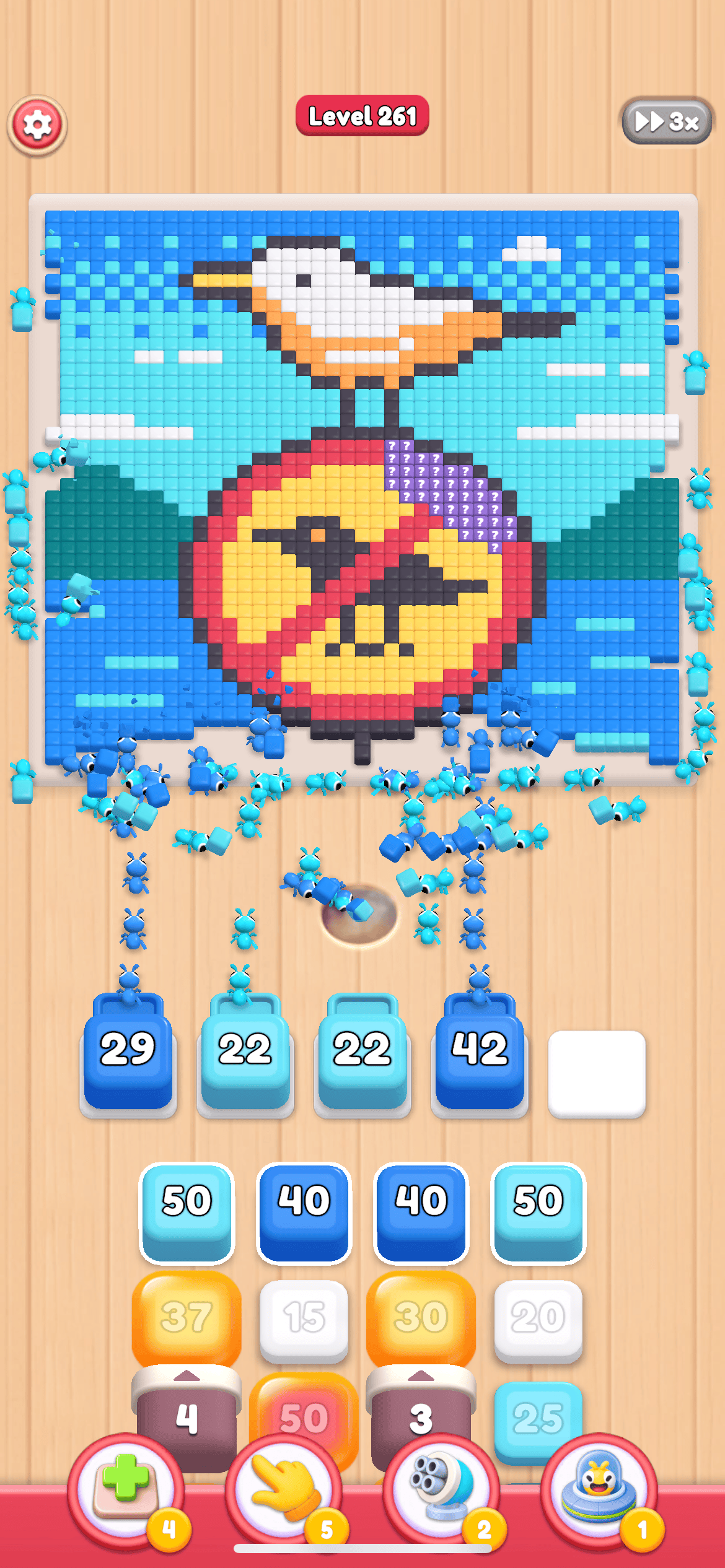

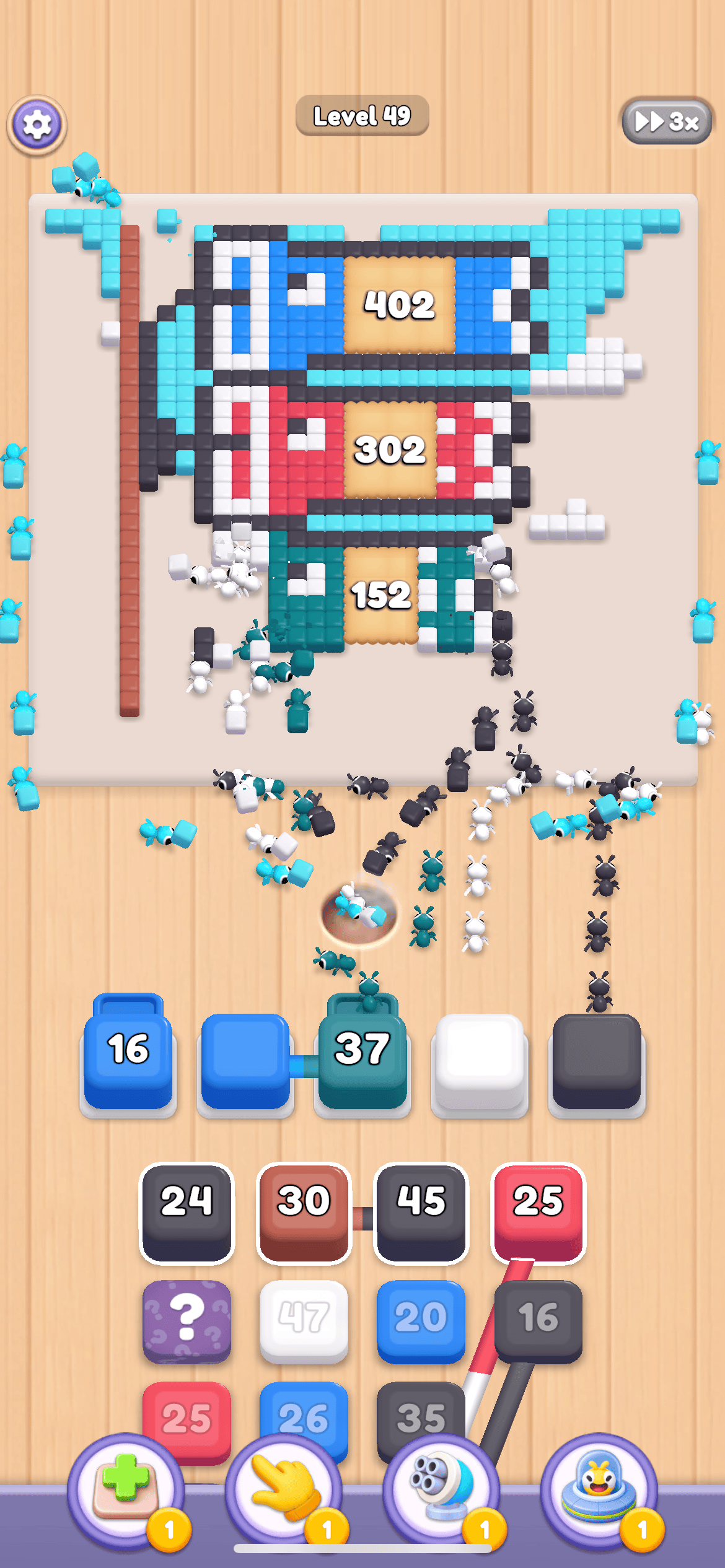
It is an ideal mobile game, with levels taking a few minutes each (although some of the more complex patterns can exceed that). It has been tainted with the scourges of mobile games – in-app purchase allowing for power ups that can get rid of some blocks, the ability to pay to continue a level, limited lives which refresh over time unless you pay – but the nature of the game means that those things are largely irrelevant. Unlike something like Two Dots or Candy Crush, where the ongoing game is random by nature in terms of new pieces appearing, each level here is predefined and solvable. You may need to play a level multiple times to know, for example, which column the mallets will appear in to get rid of the coverings, but once you know this, you can strategise to clear the right blocks. You almost never fail a level quickly enough multiple times in order to run out of lives.
And there is one one important thing to mention – tactility. As with most mobile puzzle games, I play this with music and sound off. But there is still some non-visual feedback that’s so satisfying here: each time an ant picks up one of the squares the phone gives a tiny jolt. If many ants are rushing to collect their squares at once, you can feel it; it’s not a heavy vibration, just a little buzz of recognition that you’re doing a good job. It is incredibly satisfying.
I have just completed 500 levels of this, which indicates how compelling it is. Unfortunately some of the later levels have felt a little AI-generated, and I am hoping there is an actual end point to the game rather than it progressing forever with AI support.


